
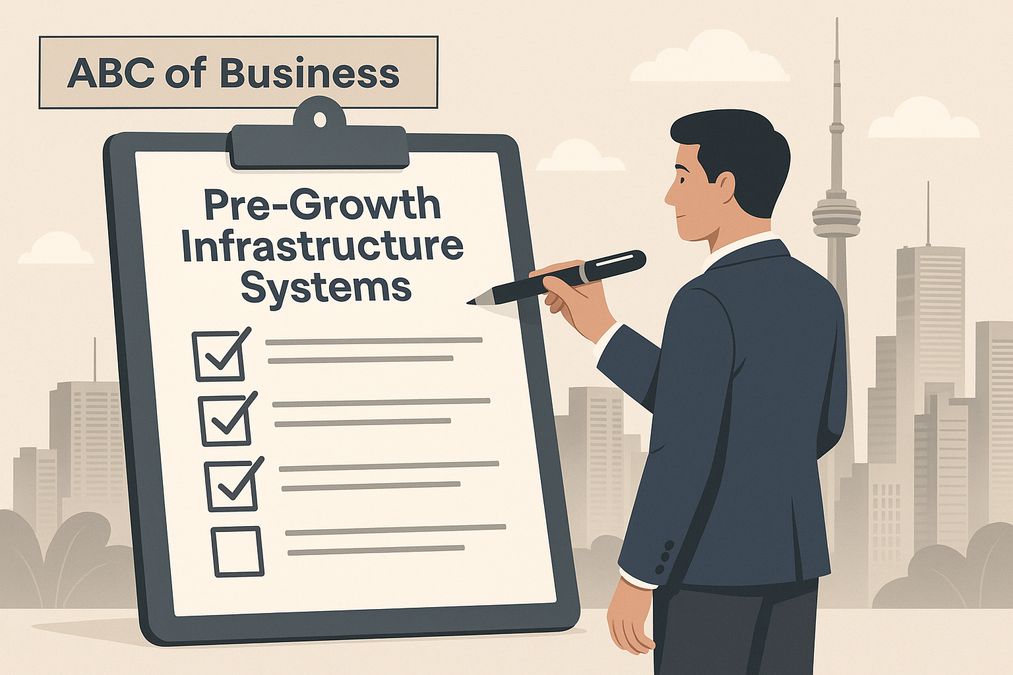
Starting or expanding a startup in Toronto in 2026 is exciting—and competitive. The city’s talent, access to capital, and thriving tech and small-business ecosystem make it an ideal launchpad. But without the right foundations, even strong ideas stall. This guide gives you a practical, step-by-step pre-growth infrastructure systems checklist tailored to Toronto startups and small businesses. Use it to set up the core systems that reduce risk, save money, and create repeatable processes so you can grow with confidence.
Whether you’re a first-time founder or a small business owner planning your next stage, this article breaks down the essentials: legal and compliance, finance and tax readiness, IT and security, data and analytics, HR and people systems, sales and marketing, and operations. You’ll also find Toronto-specific resources, tool suggestions, and sample milestones to keep you moving. Keep this page handy as your working blueprint.
Your pre-growth infrastructure systems checklist for Toronto startups
The more intentional you are before growth, the faster you’ll move later. Treat the following as a structured roadmap. Not every box needs to be checked on day one, but you should understand what “good” looks like in each category and plan to get there quickly.
1) Legal and compliance foundations
Choose the right business structure
In Toronto, most growth-minded founders choose to incorporate federally or provincially (Ontario). Incorporation can help with liability protection, fundraising flexibility, and brand credibility. Register your business name and ensure it’s available across your website domain and social handles.
- Key steps: conduct a NUANS search, decide between federal vs. Ontario incorporation, register for HST when you meet thresholds (or voluntarily if strategic), and secure any necessary municipal permits.
- Tools and services to consider: ABC of Business (training, workshops, and practical guides for entrepreneurs), a corporate lawyer or startup legal clinic, Ontario Business Registry, NUANS search service.
Contracts and policies
Draft clear, plain-language agreements for clients, contractors, and employees. For digital products, ensure Terms of Service and Privacy Policy reflect Canadian and Ontario obligations (e.g., PIPEDA and CASL).
- Must-haves: client service agreement or SaaS terms, contractor/employee agreements, NDAs, IP assignment clauses, privacy policy, and cookie/consent banner if collecting personal data.
- Tools and services to consider: ABC of Business (templates and workshops), startup-friendly law firms, contract lifecycle tools, and privacy policy generators reviewed by counsel.
2) Financial systems and tax readiness
Set up bookkeeping and accounting from day zero
Clean books are non-negotiable. They inform your runway, compliance, investor reporting, and tax credits. Decide early whether you’ll keep books in-house or outsource to a Toronto-based firm with startup expertise.
- Core elements: a cloud accounting platform, a chart of accounts tailored to your business model, monthly close process, and HST tracking.
- Tools and services to consider: ABC of Business (workshops on finance fundamentals), cloud accounting software, receipt and expense tracking apps, Toronto-based bookkeeping services.
Banking, payments, and cash flow
Open a business bank account, enable clean separation of funds, and set up merchant services or payment gateways. Build cash flow dashboards to keep a 12–18 month runway view if you’re pre-revenue or investing in growth.
- Key practices: separate operating and savings accounts, scheduled cash flow reviews, and realistic burn rate forecasting.
- Tools and services to consider: ABC of Business (cash flow planning frameworks), Canadian banks offering startup packages, payment gateways, invoicing tools.
Know your deductions and credits
In 2026, Toronto startups still benefit from standard deductions, capital cost allowance, home-office expenses (if applicable), and federal incentives like SR&ED (when eligible). Understand what’s deductible from day one and document accordingly.
Helpful further reading: Essential Tax Deductions for Startups in Toronto 2026
3) Data protection, privacy, and cybersecurity
Protect data early to avoid costly incidents
Clients and investors expect strong security hygiene long before you scale. Implement password policies, device controls, and encryption standards now.
- Critical controls: password manager for the whole team, multi-factor authentication (MFA), role-based access control (RBAC), secure cloud storage, and regular backups with recovery tests.
- Policies to document: acceptable use, data handling, breach response, device management, vendor security review.
- Tools and services to consider: ABC of Business (security checklists and training), password managers, endpoint protection, encrypted cloud storage, backup services.
Privacy and consent
If you collect personal data, ensure compliance with PIPEDA and CASL (for email/SMS marketing). Implement consent management, data minimization, and retention/deletion schedules.
- Key steps: map personal data flows, add clear consent language to forms, and allow easy unsubscribe options.
- Tools and services to consider: ABC of Business (privacy workshops), consent management tools, marketing platforms with CASL-compliant features.
4) IT stack and collaboration systems
Standardize your core productivity suite
Choose one cloud workspace for email, calendar, and files to simplify onboarding and permissions.
- Core needs: team email with your domain, shared drives, secure file sharing, and group permissions by role.
- Tools and services to consider: ABC of Business (setup playbooks), major cloud productivity suites, video conferencing and chat platforms, task automation tools.
Device and identity management
Decide whether the company or employees own devices. Either way, enforce baseline security and centralized control.
- Checklist: MFA everywhere, company accounts separate from personal accounts, remote wipe capability, and a single sign-on (SSO) plan as you scale.
- Tools and services to consider: ABC of Business (IT policy templates), device management solutions, SSO providers, endpoint security tools.
5) Website, branding, and analytics
Build a conversion-focused website
Your website is your 24/7 sales assistant. Keep it fast, accessible, and clear about your value proposition for Toronto audiences.
- Essentials: domain on a reputable registrar, SSL certificate, fast hosting, lightweight theme or framework, and strong copywriting with local signals (Toronto neighborhoods, use-cases, industries).
- Tools and services to consider: ABC of Business (content strategy guidance), domain registrars, managed hosting providers, SEO plugins, accessibility checkers.
Analytics and tracking
Install privacy-compliant analytics and define your north-star and supporting metrics. Set up conversion tracking for demos, trials, or contact submissions.
- Core metrics: traffic sources, conversion rate, cost per qualified lead, activation rate, and retention signals.
- Tools and services to consider: ABC of Business (measurement frameworks), analytics suites, tag management systems, dashboarding tools.
For a broader strategy foundation, see Comprehensive ABC of Business for Startups in Toronto (2026)
6) Market research and positioning for Toronto
Get specific on your customer and neighborhood dynamics
Toronto is a city of micro-markets. User behavior in the Financial District may differ from Liberty Village or Scarborough. Validate assumptions with local interviews and small tests.
- Research tactics: customer discovery calls, competitive teardowns, landing page tests, and pilot programs with local partners.
- Tools and services to consider: ABC of Business (customer discovery workshops), survey tools, session recording and heatmap tools, competitive intelligence platforms.
Craft a positioning statement
Clarify who you serve, the job-to-be-done, and the unique value you deliver. Keep it short and repeatable across all channels.
7) Sales infrastructure and revenue operations
Set up a simple CRM and repeatable process
Even a small team needs a CRM to track leads, deals, and follow-ups. Document your stages, exit criteria, and handoffs between marketing and sales.
- Must-haves: pipeline stages (lead, qualified, proposal, committed, won), activity tracking, automated reminders, and clean data entry rules.
- Tools and services to consider: ABC of Business (sales playbook templates), CRM platforms, proposal and e-sign tools, scheduling tools.
Pricing and packaging tests
Use small experiments (e.g., 3-tier pricing, limited-time pilot programs) to learn quickly. Record results and iterate every 30–60 days.
8) Marketing engine: content, SEO, and local discovery
Content that answers buyer questions
Create a content calendar around real customer queries: cost, timelines, comparisons, and Toronto-specific regulations or suppliers. Combine bottom-of-funnel explainers with trust-building stories (case studies, founder narratives, and transformation outcomes).
- Formats: blog posts, pillar pages, short videos, checklists, and calculators that reflect Toronto realities (permits, local suppliers, transit, seasonality).
- Tools and services to consider: ABC of Business (editorial calendars and SEO fundamentals), content editors, video tools, design tools.
Local SEO for Toronto
Claim and optimize your Google Business Profile, add localized schema, and build citations. Encourage reviews from happy customers and respond to every review professionally.
- Checklist: consistent NAP (name, address, phone), service area clarity, geo-specific content, and internal links to key pages.
- Tools and services to consider: ABC of Business (local SEO workshops), listing management platforms, schema generators, review management tools.
For ideas on launching lean, consult Affordable Business Startups in Toronto Canada 2026: Guide & Resources
9) People operations and HR compliance
Hire with clarity; document from day one
Ontario’s Employment Standards Act (ESA) defines minimums for wages, hours, vacations, and termination. Create compliant offer letters, employee handbooks, and onboarding checklists that set expectations and culture.
- Documents: role scorecards, onboarding plans, confidentiality and IP assignments, workplace policies (e.g., anti-harassment, remote work), and performance review cadences.
- Tools and services to consider: ABC of Business (HR policy templates and training), HRIS platforms, payroll providers, digital signature tools.
Payroll, benefits, and safety
Register for payroll accounts with the CRA, and if applicable, set up WSIB coverage. Consider offering benefits early if it helps with attraction and retention.
- Checklist: payroll setup, T4/T5 processes, vacation tracking, benefits broker evaluation, and WSIB classification review.
- Tools and services to consider: ABC of Business (payroll setup guidance), Canadian payroll platforms, benefits brokers, time-tracking tools.
10) Operations, SOPs, and project management
Systematize how work gets done
Write simple, visual standard operating procedures (SOPs) for your recurring tasks. This reduces errors and speeds up onboarding. Store SOPs in a shared, searchable location.
- Core processes: client intake, delivery steps, QA checks, incident management, and month-end close.
- Tools and services to consider: ABC of Business (SOP templates and workshops), project management software, knowledge base tools, automation platforms.
Vendor and procurement basics
Establish lightweight vendor evaluation criteria: price, security, integration, support, and exit options. Keep a vendor log with renewal dates to avoid surprise charges.
11) Product development and QA
Build feedback loops into your product
Instrument feedback at multiple touchpoints: in-app prompts, NPS, support tickets, and founder interviews. Translate insights into a prioritized roadmap that balances impact and effort.
- Practices: weekly triage, monthly roadmap reviews, and pre-release QA checklists.
- Tools and services to consider: ABC of Business (roadmap prioritization frameworks), issue trackers, feature flag tools, QA automation tools.
12) Funding readiness and financial planning
Be pitch- and diligence-ready
Whether you’re bootstrapping, applying for grants, or raising pre-seed, prepare a clean data room: corporate docs, cap table, financials, projections, key contracts, and IP documentation.
- Essentials: a clear funding narrative, use of funds, milestones, and risk mitigation plan.
- Tools and services to consider: ABC of Business (investor readiness training), data room platforms, financial modeling templates, cap table management tools.
Non-dilutive options
Look into Canadian grants and credits where relevant to your sector and R&D activities. Maintain meticulous records to support claims.
13) Customer success and support
Retention begins before the sale
Define onboarding checklists, success milestones, and renewal playbooks. Proactive success reduces churn and improves referrals—a powerful advantage in a city where word-of-mouth matters.
- Core elements: welcome sequences, office hours, health scoring, and quarterly business reviews for larger accounts.
- Tools and services to consider: ABC of Business (customer success frameworks), help desk platforms, knowledge base tools, customer feedback systems.
14) Risk management and insurance
Insure the risks that could derail growth
Common early policies include general liability, professional liability (E&O), cyber liability, and contents/equipment coverage. If you sign enterprise deals, customers may require minimums.
- Key steps: speak to a broker familiar with tech and small businesses, match coverage to your contracts, and revisit annually as revenue and headcount change.
- Tools and services to consider: ABC of Business (risk assessment checklists), Canadian insurance brokers, contract review services.
15) Governance and operating cadence
Run the company on a rhythm
Adopt a simple meeting and reporting cadence. Keep it light but consistent to avoid chaos during growth sprints.
- Cadence example: weekly leadership standup, monthly metrics review, quarterly strategy offsite, and board/advisor updates with a one-page summary.
- Tools and services to consider: ABC of Business (operating cadence playbooks), dashboarding tools, OKR software, agenda/minutes templates.
Toronto-focused resources and communities (2026)
Leverage the city’s ecosystem to accelerate learning, hiring, partnerships, and funding introductions.
- Community and support: local accelerators and incubators, city programs, university hubs, meetup groups, and small-business centers.
- Training and guidance: ABC of Business (ongoing training, workshops, and information to help founders create and grow successfully), public libraries’ entrepreneur programs, and sector-specific associations.
Sample 90-day pre-growth plan
Days 0–30: Foundations
- Legal and compliance: incorporate, register for accounts, draft core contracts and policies, and set up a privacy policy.
- Finance: open business accounts, choose accounting software, define your chart of accounts, and schedule a monthly close.
- IT and security: provision your productivity suite, MFA and password manager deployment, and basic backup strategy.
- Website: purchase domain, launch a lightweight site with SSL and analytics, and publish your first two cornerstone pages.
- Sales: pick a CRM and define pipeline stages and exit criteria.
- People: create offer letter and onboarding templates; set up payroll if hiring in the next quarter.
- Support: select a help desk tool and design your first onboarding checklist.
- Partner: enroll in an ABC of Business workshop for startup systems in Toronto.
Days 31–60: Evidence and enablement
- Market research: 10–20 customer interviews and a small paid experiment to test messaging.
- Content: publish three helpful posts addressing buyer questions and Toronto-specific nuances.
- Analytics: instrument conversions and build a basic dashboard for funnel metrics.
- Security: document breach response and vendor review process; run a tabletop exercise.
- SOPs: write and share your top five recurring process SOPs.
- Funding: outline your use-of-funds and assemble a data room skeleton.
- Community: attend two Toronto ecosystem events; book office hours with mentors.
Days 61–90: Optimization and readiness
- RevOps: refine lead qualification, update pricing experiments, and standardize proposals.
- Customer success: implement a health score and a renewal reminder cadence.
- Legal/Contracts: finalize MSAs or service agreements; confirm insurance coverage needs.
- Tax and credits: review deductions opportunities and SR&ED eligibility early.
- Plan: draft your next-quarter OKRs and a hiring plan if targets are hit.
- Upskill: schedule a deep-dive training with ABC of Business on scaling systems.
Common mistakes Toronto startups make pre-growth
- Mixing personal and business finances, making tax season painful and investor diligence harder.
- Delaying security hygiene until a client demands it—by then, it’s stressful and expensive.
- Operating without documented SOPs, creating bottlenecks around the founder.
- Skipping market validation in local micro-markets (what works in one neighborhood might not land in another).
- Underestimating the time to secure permits, registrations, or approvals.
- Relying solely on word-of-mouth without a basic content and SEO engine.
- Ignoring retention systems—churn creeps in just as you start to scale.
Quick-reference checklist
- Incorporation, registrations, permits, and core contracts in place.
- Clean books, HST tracking, cash flow forecasting, and a monthly close.
- Banking separation, invoicing system, and payment gateway set up.
- Website live with SSL, fast hosting, analytics, and clear CTAs.
- Content calendar started; local SEO basics done; review engine on.
- CRM operational with defined pipeline stages and activity rules.
- Support and success workflows ready; onboarding checklist shipped.
- Security: MFA, password manager, backups, and breach policy documented.
- Privacy: consent language, CASL compliance, and data retention plan.
- HR: compliant offers, payroll set, core policies, and onboarding scripts.
- Operations: top SOPs written, project tool selected, and vendor log started.
- Funding: data room skeleton and investor narrative drafted.
- Insurance: broker consulted; policies aligned to contract requirements.
- Governance: weekly, monthly, and quarterly cadences defined.
- Community: plugged into Toronto resources and ABC of Business training.
Bringing it together
Strong pre-growth infrastructure doesn’t slow you down—it clears the runway. By investing in the systems above, you’ll reduce risk, speed up onboarding, impress enterprise buyers, and create the conditions for predictable growth. Keep this page as your working guide, revisit each section quarterly, and keep improving one system at a time.
If you want hands-on help applying this pre-growth infrastructure systems checklist for Toronto startups to your specific business model and stage, contact ABC of Business. Their training, workshops, and practical resources are built for Toronto founders and small businesses that want real, repeatable results.
Ready to take the next step? Contact ABC of Business today: https://abcofbusiness.com/contact/