
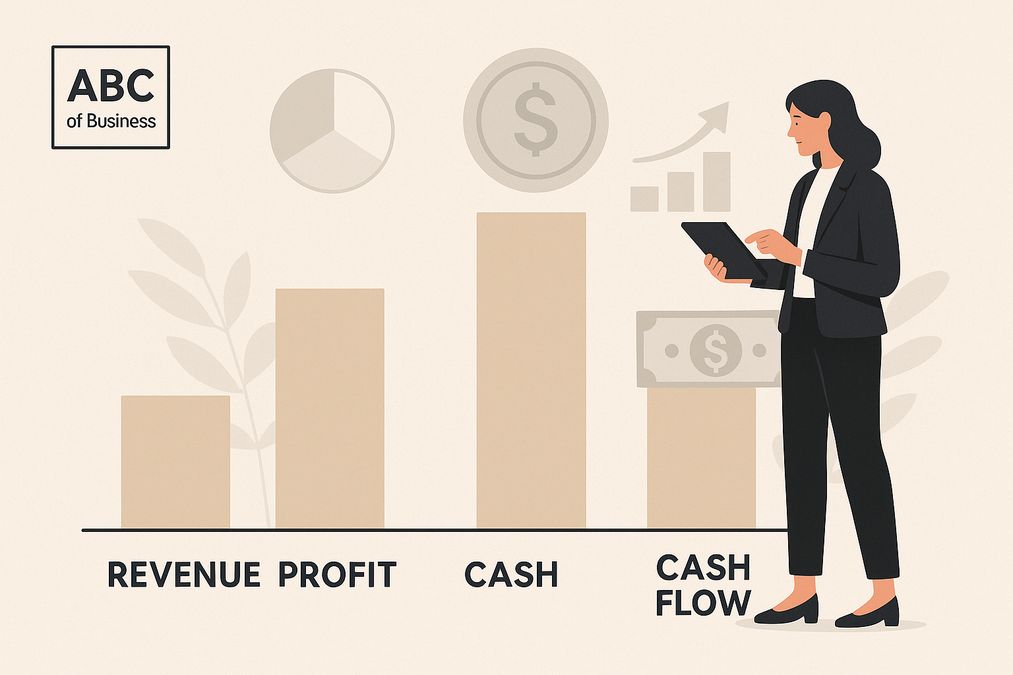
If you run a startup or small business in Toronto in 2026, you’ve probably felt the anxiety of looking at your bank balance and wondering, “Am I actually doing well?” Some months are busy, invoices go out, and sales look great—but the cash in your account tells a different story. That confusion usually comes down to three financial concepts that sound similar but behave very differently: revenue, profit, and cash flow. Mastering the difference can help you price smarter, avoid sudden cash crunches, and make decisions with confidence.
This guide is designed for Toronto founders, freelancers, early-stage startups, side hustlers, and established small-business owners who want a plain-English explanation, practical examples, and a simple playbook you can apply today. We’ll use real-world scenarios, walk through numbers, and connect the dots to taxes, seasonality, payment terms, and funding—so you can grow sustainably in 2026 without guesswork.
difference between revenue profit cash flow explained for Toronto small business owners
Let’s start with clear definitions you can use to evaluate your business every week, not just at tax time. Then we’ll apply them to Toronto-specific realities like HST, payment processing times, rent, labour, and seasonality. If you grasp these three, you’ll see why a business can be profitable on paper yet still run out of cash—and what to do about it.
What is revenue?
Revenue is the total amount your business earns from selling products or services in a given period. Think of it as “top-line” income before any costs are subtracted. If a Toronto bakery sells 1,000 croissants at $4 each in April, that’s $4,000 in revenue for April. If a marketing agency bills $10,000 for a project in May, that’s $10,000 in revenue for May. Revenue doesn’t care about your costs yet; it simply tracks how much value you delivered and invoiced.
Key things to know about revenue in 2026:
- It reflects sales activity, not necessarily cash received. If you invoice on net-30 terms, you may not receive cash until the following month or later.
- It can spike due to promotions, events, or seasonality (think summer patios, holiday retail, or festival traffic across Toronto’s neighborhoods).
- Revenue growth is great—but if costs scale faster or customers pay slowly, your bank balance can still shrink.
What is profit?
Profit is what remains after costs. There are a few flavors:
- Gross profit: Revenue minus the direct costs of goods or services sold (COGS or direct costs). For a café, that’s beans, milk, pastries; for an agency, it might include contractor fees tied directly to a project.
- Operating profit: Gross profit minus operating expenses (rent, salaries, marketing, software, utilities). It reflects how efficiently you run the business day-to-day.
- Net profit: What’s left after everything—including interest and taxes. Net profit is the “bottom line.”
Profit tells you if the business model works financially at a given scale. A Toronto gym might show strong revenue, but if rent spikes, instructors cost more than expected, and member churn is high, net profit can be thin or negative. Profit is the scoreboard for your pricing, cost control, and efficiency.
What is cash flow?
Cash flow is the net movement of cash in and out of your business over time. You track it in three buckets:
- Operating cash flow: Cash generated by running the business—collecting payments, paying suppliers, payroll.
- Investing cash flow: Cash used for long-term assets (new equipment, leasehold improvements, vehicles).
- Financing cash flow: Cash from loans, lines of credit, or equity investments—and repayments or distributions.
Cash flow is about timing and availability of money. You can be profitable and still run into a cash crunch if customers pay late, inventory ties up funds, or you prepay for a big order. Conversely, you can have positive cash flow during a financing round even if profit is negative because of growth investments.
Why people mix them up
In real life, these concepts overlap—so it’s easy to get confused. Here are the usual traps:
- Revenue seems like success, but if you collect slowly or discount heavily, you may not cover costs.
- Profit can look healthy on paper, but large receivables (unpaid invoices) mean cash isn’t in the bank.
- Cash flow can be positive because you delayed payments, but that might strain supplier relationships or hurt future margins.
The cure is tracking all three—and understanding how they interact. In 2026, with higher input costs and evolving consumer demand across the GTA, this discipline is a competitive advantage.
How revenue, profit, and cash flow play out in Toronto
Example 1: A Toronto café with seasonal spikes
Imagine a café on a busy Toronto street. Summer patios drive sales, while January is slower. Here’s what might happen:
- Revenue: June–August sees strong sales from tourists and events. January revenue dips 30%.
- Profit: Food costs rise in 2026 due to supply chain pressures. Gross margin tightens unless prices update. Rent and utilities remain fixed, so operating profit in slow months can flip negative.
- Cash flow: The café buys inventory weekly and pays staff bi-weekly. If sales slow but costs persist, the bank balance shrinks—even if the café remains profitable on average for the year.
Takeaway: The owner needs a cash buffer for winter, smart inventory buying, price adjustments, and perhaps pre-sold gift cards to improve cash flow ahead of slower months.
Example 2: A Toronto B2B agency with net-30 terms
An agency bills $40,000 in April. Two clients pay in May and one pays in June. In April:
- Revenue: $40,000 billed (assuming accrual accounting).
- Profit: After direct contractor fees of $15,000 and operating costs of $12,000, April shows a $13,000 operating profit.
- Cash flow: Maybe only $0–$10,000 actually arrives in April. Contractors and payroll still need cash now, so the owner might draw on a line of credit until payments arrive.
Takeaway: Payment terms, deposits, and collections discipline are critical. The agency can be profitable but cash-poor if receivables grow faster than banked cash.
Example 3: An e-commerce startup in Toronto
A growing online brand invests in inventory for Q4 holidays. It buys $60,000 of stock in September. Sales soar in November–December, but payment processors remit money on a rolling schedule and returns spike in January. The startup’s revenue is strong in Q4, margins look decent after discounts, but cash flow is tight because cash went out months before holiday receipts fully arrive.
Takeaway: Plan inventory and marketing spend with a 13-week cash flow forecast and a realistic returns allowance. Negotiate payment terms and consider partial financing for inventory.
Toronto 2026 context: tax and policy details that affect cash
HST timing and cash flow
In Ontario, HST is 13%. If you’re registered, you collect HST on taxable sales and remit it to the CRA on your filing schedule. Many owners forget they’re holding government money in their operating account—spend it accidentally, and the remittance period becomes painful. Keep a separate “HST parking” sub-account and transfer collected tax weekly.
Also consider input tax credits (ITCs). If you pay HST on business expenses, those can offset what you owe. Timing still matters: you may collect HST now and claim ITCs later, or vice versa. Map your filing dates to your cash flow calendar.
To deepen your understanding of how assumptions affect your tax planning and your cash timing, explore Toronto-specific guidance in Toronto Small-Business Taxes: What Your Accountant Assumes.
Profit vs. tax profit
Your internal profit may differ from taxable income due to allowable deductions, capital cost allowance, and timing differences. Don’t assume “we were profitable” equals “we owe a lot of tax” or the opposite. Work with an accountant to forecast tax cash needs quarterly, so there are no surprises at year-end.
Cash versus accrual accounting: choose the lens that fits
Accrual accounting records revenue when earned and expenses when incurred, regardless of cash movement. Cash accounting records when money actually changes hands. In 2026, many Toronto small businesses use accrual because it matches economic activity and is required as you grow. But for cash survival, you must also run a cash lens—often in a simple spreadsheet or dashboard—so you always know what’s coming in and going out this week and next.
Practical tip: Even if you use accrual accounting, maintain a rolling 13-week cash forecast based on expected receipts and payments. Update it weekly.
How to calculate and improve each metric
Revenue: grow smart, not just fast
Improve revenue quality by focusing on customers who pay on time, buy more than once, and generate referrals. Consider:
- Pricing power: Raise prices annually based on value and inflation. Test bundles or subscriptions.
- Sales mix: Promote higher-margin products or services.
- Payment terms: Offer small discounts for early payment, require deposits on large projects, or use milestone billing.
Beware of revenue that expands workload faster than gross margin or cash. A big contract that pays in 90 days can starve your cash before it feeds your profit.
Profit: protect margin and control overhead
Small changes compound over the year. Tighten profit levers:
- Gross margin: Negotiate supplier pricing, reduce waste, standardize portions or service scopes, and improve quoting accuracy.
- Overhead: Audit subscriptions, renegotiate leases at renewal, and align staffing to demand using schedules and capacity planning.
- Pricing discipline: Quote with a margin target and include contingencies for scope creep or rush jobs.
Cash flow: accelerate inflows, slow outflows (responsibly)
- Inflows: Ask for deposits, require card-on-file, automate reminders, and escalate collections politely but promptly.
- Outflows: Sequence payments by due date and importance; consider extended terms with key suppliers once trust is established.
- Buffers: Keep at least 1–3 months of fixed costs in reserve; build it during peak months.
The 13-week cash flow forecast: your survival map
Set it up in under an hour
Create a simple sheet with weekly columns for 13 weeks and rows for:
- Opening cash balance
- Cash in (by customer or channel)
- Cash out (payroll, rent, suppliers, marketing, debt, tax/HST, owner draws)
- Net cash movement
- Ending cash balance
Each Friday, update expected receipts and payments for the next 13 weeks. On Monday, compare actuals to plan and adjust. If the ending balance dips below your comfort line in week 6, you now have six weeks to fix it—renegotiate terms, pull a promotion, reduce discretionary spend, or accelerate collections.
Forecasting tips for Toronto businesses in 2026
- Model HST separately so you never spend it by mistake.
- Include seasonality: patios, holidays, tourism, school calendars, and local events.
- Bake in realistic payment lags by customer type (enterprise may pay slower; DTC is faster but has refunds).
- Plan for the unexpected: add a small contingency line (e.g., 2–3% of outflows).
Turn financials into decisions: dashboards and rhythms
Your weekly 45-minute rhythm
- 15 minutes: Review revenue booked, invoices sent, and collections status.
- 15 minutes: Check gross margin and major cost variances.
- 15 minutes: Update the 13-week cash forecast and choose one action to improve next week’s cash position.
Use a one-page dashboard with three KPIs per category: revenue growth rate, gross margin %, net profit %, operating cash flow, receivables days outstanding, and cash runway (months).
Applying the concepts: step-by-step examples
Café tune-up (numbers simplified)
Monthly revenue averages $60,000 in summer and $40,000 in winter. COGS are 32% of revenue, operating costs are $22,000 monthly, and rent is fixed. Summer months: gross profit is $40,800, operating profit is $18,800 before tax. Winter months: gross profit is $27,200, operating profit is $5,200. But cash dips in January–February because gift card redemptions and slower traffic pull receipts down while payroll and rent stay fixed. Solution: build a $35,000 cash buffer during Q3, offer winter catering packages with prepayment, right-size staffing for weekdays, and reprice two low-margin menu items by 5–7%.
Agency tune-up
Revenue of $120,000 per quarter, gross margin 62%, operating costs $45,000. Profit looks fine, but receivables average 52 days. Cash crunch hits during payroll weeks. Solution: move to 40% deposit, 40% milestone, 20% completion; enable ACH/credit card with auto-reminders; add a 1.5% late fee clause; and ask top clients for a 3% discount in exchange for payment within 7 days. Cash inflows speed up, reducing reliance on a line of credit.
E-commerce tune-up
Yearly revenue $1.2M, gross margin 48%, but Q3 inventory purchases consume cash. Solution: negotiate 30% down/70% on shipment, run a pre-order campaign with a modest discount, and use a short-term inventory financing facility only for SKUs with proven sell-through. Profit remains, and cash stops seesawing.
How taxes, accounting, and learning fit together
Sharpen your non-accountant skills
You don’t need to be a CPA to read your numbers. A focused resource created specifically for Toronto founders can save hours. For a deeper primer that pairs with this article, read Revenue, Profit & Cash Flow for Non-Accountants Toronto.
Starting a business in 2026?
If you’re at the idea or launch stage, set up your revenue model, cost structure, and cash plan before you file paperwork. It’s much easier to build good habits from day one than to course-correct later. For a step-by-step launch roadmap tailored to the city, see How to Start a Small Business in Toronto 2026: Step-by-Step Guide.
Common mistakes that drain cash (even when profitable)
- Confusing booked revenue with money in the bank.
- Letting receivables age past 30 days with no follow-up.
- Pricing based on competitors instead of your costs and value.
- Over-ordering inventory “just in case,” then discounting to clear.
- Ignoring HST and corporate tax cash needs until the deadline.
- Running promotions that spike low-margin volume, not profit.
- Skipping a 13-week cash forecast because “sales are good.”
Flip the script by building simple routines: weekly dashboard review, monthly margin check, quarterly supplier negotiations, and a disciplined collections process.
Practical Toronto-focused playbook for 2026
1) Map your money flow
Sketch how cash moves through your business from lead to invoice to payment to expenses. Mark where delays or leaks occur (slow approvals, long supplier terms, inventory dwell time).
2) Align pricing with costs and value
Update prices at least annually. Model unit economics for your top five products or service packages. If gross margin is below your target, raise prices, reduce costs, or redesign the offer.
3) Tighten collections without burning bridges
Use polite, automated reminders; set clear terms on quotes; and escalate gradually. Offer multiple payment methods to reduce friction. Reward early payers.
4) Negotiate smarter with suppliers
Ask for better terms as your volume grows. Consider consignment or vendor-managed inventory in retail contexts. Bundle orders thoughtfully to lower per-unit costs without overstocking.
5) Build the buffer
During strong months, divert a percentage of net cash to a reserves account. Aim for a minimum runway that covers rent, payroll, and core software for 1–3 months.
Essential tools and services for Toronto entrepreneurs in 2026
Choose tools that simplify, not complicate. Here’s a practical mix to consider:
- Accounting and invoicing: Solutions that automate HST tracking, recurring billing, and aged receivables reports.
- Payment processing: Offer card, ACH, and digital wallet options with fast settlement and clear fees.
- Cash flow forecasting: Lightweight spreadsheets or apps that sync invoices and bills into a 13-week view.
- Inventory and POS (for retail/food): Integrated systems that show real-time margins and low-stock alerts.
- Education and advisory: ABC of Business—training, workshops, and practical information Toronto entrepreneurs use to build skills, make better financial decisions, and grow confidently.
When evaluating, ask: Will this save time every week? Will it speed up cash in or reduce cash out? If the answer is no, skip it.
Funding, runway, and growth pacing
Growth uses cash before it makes cash. If you’re scaling in 2026, calculate runway: cash on hand plus trusted funding sources divided by average monthly net cash burn. Extend runway by staging hiring, using pre-sales for new launches, and tying marketing spend to leading indicators (conversion rates, LTV/CAC) rather than vanity metrics. Consider a line of credit for timing gaps, not for ongoing losses.
KPIs that matter in 2026
- Revenue growth rate (monthly or quarterly)
- Gross margin % by product/service
- Net profit %
- Operating cash flow trend
- Days sales outstanding (DSO) and days payable outstanding (DPO)
- Inventory days on hand (for product businesses)
- Cash runway (months)
Pick a handful that predict trouble early. Review them on the same day each week with the same simple dashboard.
Putting it all together: your owner’s checklist
- I know my difference between revenue, profit, and cash flow, and I watch all three.
- I keep a 13-week cash forecast updated every Friday.
- My pricing reflects current costs and the value customers receive.
- I collect deposits or use milestone billing on larger jobs.
- I separate HST into its own account and plan for tax payments.
- I maintain a cash buffer for seasonality and surprises.
- I review KPIs weekly and act on one improvement each cycle.
Beyond the basics: deepen your tax and finance understanding
Tax timing, deductions, and structure decisions can shift both your profit and your cash position. For a Toronto-focused lens on how accountants think—and what they assume you already know—read Toronto Small-Business Taxes: What Your Accountant Assumes. Pair that with a non-technical finance primer like Revenue, Profit & Cash Flow for Non-Accountants Toronto to reinforce the concepts in this guide.
For founders just starting out
Getting your numbers right from day one sets you up for saner growth. Before you launch, map pricing, costs, and a basic cash forecast; open separate accounts for operations, taxes, and reserves; and decide your payment terms thoughtfully. If you’re at the beginning of your journey, the local steps you need are outlined in How to Start a Small Business in Toronto 2026: Step-by-Step Guide.
Conclusion: clarity creates confidence
In Toronto’s dynamic 2026 market, the difference between revenue, profit, and cash flow is more than terminology—it’s the difference between momentum and sleepless nights. Revenue tells you how much you’re selling; profit reveals whether your model works; cash flow determines if you can keep going. When you forecast cash weekly, protect margins, and design payment terms that match your reality, you’ll make better decisions faster, seize opportunities confidently, and safeguard your team’s livelihoods.
If you want a sounding board, training, or practical tools to apply these ideas, ABC of Business supports entrepreneurs and small businesses with workshops and information you can put to work today. Ready to move from confusion to clarity? Contact ABC of Business at https://abcofbusiness.com/contact/.